

By Jonathan Latham, PhD.
It is a remarkable fact that, despite its purported emphasis on science, no one who led the US pandemic response in its first year, not Robert Redfield, not his colleague Deborah Birx, nor his nemeses Tony Fauci, Alex Azar, and Scott Atlas, had the standard qualification expected of a scientist, a PhD. Nor did any of them have a particularly exceptional research career. So what qualities caused them to rise to the top?
Midway through his new book, Redfield’s Warning, Robert Redfield, who who was head of the US CDC when COVID19 first broke out, recounts an acrimonious meeting with his boss, Health Secretary Alex Azar. The meeting, which occurred very early in the pandemic, pits Redfield resisting Azar’s expectation that Morbidity and Mortality Weekly, the CDC’s premier in-house scientific journal, would comply with Azar’s wish to softpedal the seriousness of the pandemic. Redfield told Azar that MMWR follows a strict scientific process and so is independent even of him. This incident is interesting on multiple levels.
Firstly, Redfield positions himself in his book as a truth teller and a follower of science. There are good reasons to think that Redfield lived up to this aim better than just about any other US scientific leader during the pandemic. 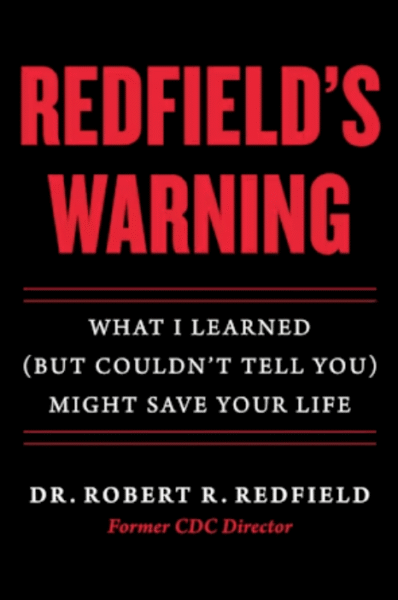 Yet Redfield’s book doesn’t have references or footnotes or even an index, so it’s difficult or impossible to verify anything he writes or concludes. Since a key element of good scientific methodology is to provide an evidence trail this is frustrating, to say the least. Certainly it lessens confidence in his judgements. Secondly, as a leader whose pedigree dates back to AIDS in the 1980s and its similarly contentious political dynamic of how seriously to portray the pandemic to the public, it presents as strange that Redfield, who ended up being banned from speaking on TV, barred from the advisory process, and then losing his job entirely, lacked a more subtle response than the simple defiance he portrays. The reader is left to wonder how many of the most critical scientific decisions get made not by weighing the evidence but by the process of bawling out and shouting back.
Thirdly, the incident serves as a reminder of a very basic fact in government that, perhaps because its not a very reassuring one, is often lost sight of. Governments like to present themselves as following the science and naturally this leads people to expect it. Yet we need also to appreciate the intense pressure that there is always likely to be on scientific advisors to either tailor their advice or stitch it from whole cloth, and how long science advisors who are unwilling to compromise their profession are likely to last. So while Fauci and Francis Collins (head of NIH) kept their jobs for decades, Redfield was soon purged. In wondering by what routes science gets corrupted historians, sociologists, and others, have sometimes documented the distorting effects on it of personal failings, such as vanity (Waller, 2002), the effects of societal biases, such as patriarchy (Harding, 1986), or of financial avarice (Krimsky, 2003). But the ever-increasing institutionalisation of science, especially since WWII, has created a source of pressure that is usually well hidden: manipulation from above for the purpose of making advisors lives easier. So whereas many wonder if science is more corrupt than it once was, they seldom consider the cumulative deliberate molding of science by its own leadership, when it may even be the most problematic corrupting influence of them all.
Redfield came to believe that SARS-CoV-2 almost certainly came from, and was created in, the Wuhan Institute of Virology. Certainly, dangerous and unnecessary genetic manipulation of viruses is worthy of a warning. Yet Redfield could have offered many other, more generalisable, warnings. In the very early days of the pandemic the World Health Organisation created a test for COVID19 that became widely used outside the US. Redfield’s CDC ignored it and developed their own. The US FDA refused to validate CDC’s test, leaving the US, months into the pandemic, with no test at all. Redfield doesn’t mention this disastrous episode, even though it destroyed the possibility of tracing or preventing infections. Probably nothing is as critical in a pandemic as having a good test and yet few issues were as contentious or as mismanaged. The problems run deep. In academic virology, virus detection is routine, but academic tests are not designed for pandemics. In an outbreak what truly matters is whether a person is infectious or whether they are immune, not whether they have a detectable virus or not. There is a big difference between these states. Yet COVID19 testing remained focussed on the presence/absence question that preoccupies academia, meaning that people were wrongly treated as contagious, confined unnecessarily, and often kept from working, including in essential services. This specific lesson could have been learned during the West African Ebola outbreak of 2014, but it seemingly wasn’t. In that outbreak US researchers (with actual PhDs) failed to develop timely and effective tests, and this contributed massively to the epidemic’s unnecessary spread. One wider lesson here is that researchers often failed to break out of their academic narrowness when the pandemic they predicted actually arrived.
In his final pages Redfield argues that healthcare leaders lost the trust of the population, primarily through their lack of candour. But it’s hard to see what level of candour they can actually provide. When modern leaders like Azar insist on creating self-serving short-term narratives to the exclusion of other qualities that once were associated with positive leadership: principles, vision, humility, or integrity, then expecting their subordinates to do better is surely naif. Redfield observed this failing almost everywhere, from Trump downwards. We should be grateful that he notes this. But he only appreciates to a limited extent that failing to tell the truth can have other causes, including insufficient scepticism, and that this insufficiency might apply also to himself. Thus another failing prevalent in Western democracies is unwillingness or inability of leaders to question the expert advice they are offered and expected to use and transmit. When Redfield is told that Pfizer’s vaccine is ‘95% effective’ he expresses no doubts. And like every one else he assumed, incorrectly, that non-symptomatic individuals could not transmit COVID19. He also asserts his certainty that HIV spilled over from wild Chimpanzees. He admits no doubts about this even though there is no specific evidence and no coherent theory for why three HIV spillovers emerged in the 1960s-1970s but none in the millions of years of human monkey coexistence before or since.
It’s worth considering here, since it’s rather important, what proper scepticism would involve. Being a sceptical leader would require Redfield to have had almost limitless time and expertise (during a pandemic). Alternatively, he could have delegated sceptical functions to specific subordinates. Or he could have inherited an agency where critical thought and scepticism are the culture, baked in, as it were. Spelled out, these qualities may sound unrealistic, but it is the central myth of science that such a state of mind pervades all its institutions. But it is just a myth, and the pandemic exposed it. The difference between the science of the pandemic response and normal everyday science was not that the COVID19 pandemic was special. Rather, throughout the pandemic normal institutional science prevailed, that is to say shoddy, opaque, self-serving, politicised, assumption-driven, smug science prevailed. Scientists exhibited exactly the failings that science claimed not to have. What distinguished the pandemic was that, when reality, in the shape of the COVID19 virus, bit back on its pronouncements, as it routinely and often rapidly did, social media (and mostly not legacy media) took merciless note. Thus was public trust in science severely damaged. But though scientists largely did it to themselves the current narrative blames only the messenger: social media.
References
Sandra Harding (1986) The Science Question in Feminism, Cornell University Press.
Norriss Hetherington (1988) Science and Objectivity, Iowa University Press.
Sheldon Krimsky (2003) Science in the Private Interest, Rowman and Littlefield.
John Waller, 2002 Fabulous Science, Oxford University Press.
If this article was useful to you please consider sharing it with your networks.
